The real world
Built on the real map
Every town, district and canal in the game exists. The people in it don’t.
- 217 countries
- 7,139 towns and cities
- 14,778 boroughs
- 175,554 districts
01 · Places and districts
Your town is on the map
Towns and cities come from GeoNames, with their real population. Size sets the type: a village under 10,000 people, a city from 100,000, a metropolis from two million, a world city from eight million, plus a few money capitals such as Amsterdam and Paris.
Districts are real neighbourhoods with their real names. Where an open source has the borders, the game uses them: CBS neighbourhoods in the Netherlands, census tracts in the United States, communes and arrondissements in France. Boroughs are the real ones where they exist, like the boroughs of London.
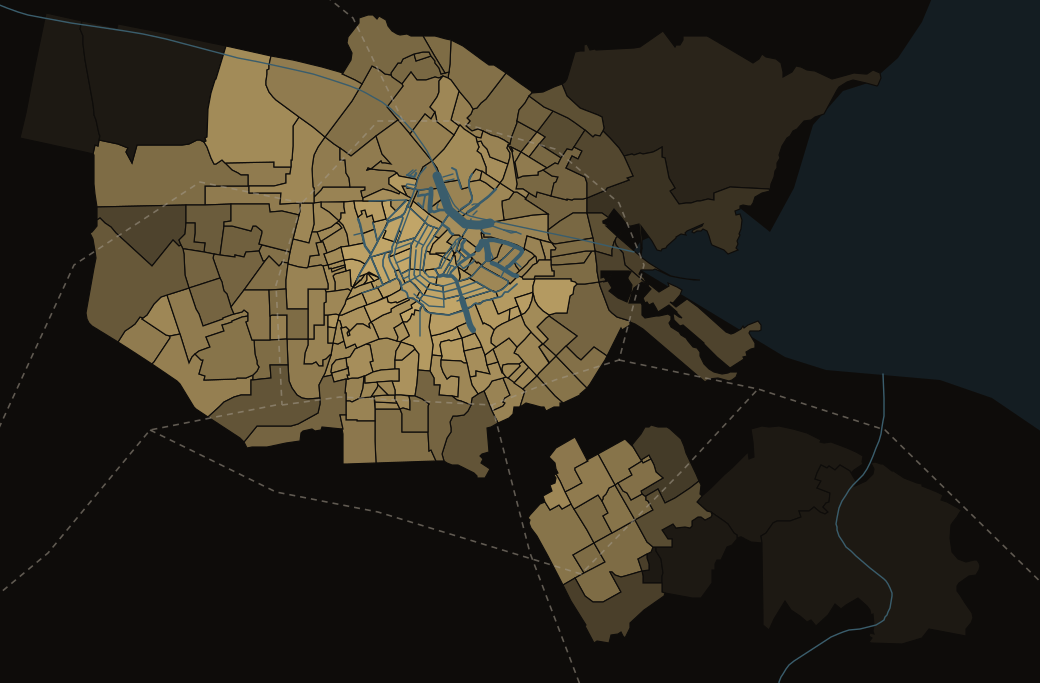
Amsterdam in the game
- 921,468 inhabitants
- 12 boroughs
- 229 districts
- 120 stretches of canal
- A1 · A2 · A4 · A5 · A8 · A9 · A10
little builtdensely builtwater and canalsmotorways
District borders: CBS Wijk- en Buurtkaart 2023 (CC BY 4.0), merged into game districts. Built-up share: GHSL, European Commission JRC (CC BY 4.0). Canals: © OpenStreetMap contributors (ODbL). Water: Natural Earth.
02 · Population
Where the people are
Every town has its real population, and the game spreads it over its districts: half evenly, half by area. A dense old centre gets small districts full of people. In Amsterdam a district holds between 2,065 and 44,706 people.
Those numbers do the work. They decide how many buildings fit in a district, how many customers your bar or shop gets, and how much a city’s market takes in. Tourists, nightlife crowds and commuters come on top in busy places. A country’s appetite for each product grows with its population.
03 · How high, how dense
Measured from space
The Global Human Settlement Layer maps every square kilometre on Earth: how much ground is built on and how much volume stands on it. From that the game knows, for 171,863 districts, the average building height and how tightly they are packed.
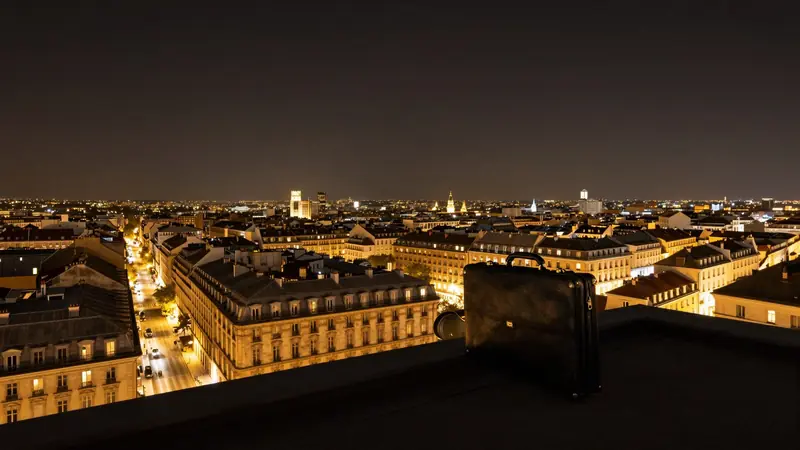
The street you walk through follows it: facade height, how close the buildings stand, whether towers fit. Amsterdam measures 12.6 m in a typical district and nowhere above 16.8 m: low, dense and old. The tallest district of New York averages 30.9 m. Where the average passes 24 m, high-rise belongs in the street. Below 9 m there are no towers, not even in the centre.
04 · Wealth and the economy
Rich country, poor district
Each country starts from its real income per head, rounded. Every district then sits poorer or richer than that, from what is known about the neighbourhood. That is the game’s estimate, not official income data.
Wealth runs through everything with a price:
- Property. Square metres × price per m² × country × city × district. The country follows its income, with a few housing markets set by hand. Big and famous cities cost more. Villa districts cost more, industrial estates less, and rivals on the street push prices down. Then each city’s property market moves every round.
- Rent follows what the building is worth.
- Bars, clubs and shops earn from the people around them: customers × spending, and spending is the country’s income times the district’s wealth.
- Jobs and staff. The take from a job and what your people bring in grow with the wealth of the district.
- What sells where. Every product has a street price per country, rounded and indicative, after the street prices in the UNODC World Drug Report. Close to where it’s made it’s cheap, far away it’s expensive. Then supply and demand move it every round.
- Local rules. A coffeeshop only opens where the country tolerates it, a dispensary only where it’s partly legal. A penthouse needs a big city and a rich district.
One studio of 32 m², five cities
Asking price in the game, in an ordinary residential district, with the property market at rest.
- Eindhovenincome per head $60,000 $132,000
- Amsterdamincome per head $60,000 $370,000
- Parisincome per head $46,000 $250,000
- New Yorkincome per head $80,000 $380,000
- São Pauloincome per head $10,000 $60,000
05 · Police, rivals and heat
Who is watching
Police attention in a district comes from the size of the town, how corrupt the country is, how rich the district is and what kind of place it is: a financial district is watched closely, an industrial estate much less. Anonymity is how easily you disappear into the crowd: easy in a big city or a nightlife district, hard in a villa district.
Rivals start from the country’s real homicide rate (UNODC, rounded), with more in big cities and in poorer districts. A raid on your building depends on the police and on the neighbours, and is less likely where nobody knows anybody.
Heat builds in three layers: the district you’re working, the town’s police, and the country. Country heat rises slowly and fades over days. It is felt at the border and on the motorway. Another country is a clean slate, but your file travels with you.
06 · Water, ports, airports and roads
Real coasts, real canals
- 1,984 towns on a river, 1,527 on the sea. Coasts, lakes and rivers come from Natural Earth. A town without water has no harbour.
- 39 towns with real canals from OpenStreetMap, as they actually run and with their measured width. On the city map and in the street.
- 170 port towns. A list of the world’s big container ports and the ports known from smuggling news. The district nearest the port becomes the harbour quarter.
- 3,468 towns with an airport, from large hubs to small airfields, from OurAirports.
- 1,698 towns with real motorways, with their real numbers on the signs and their real route through and around town (Natural Earth, filled in where it misses roads).
Train stations, universities, hospitals, stadiums and shopping centres sit where GeoNames puts them. Their names are left out: many carry the name of a person or a brand.
07 · The street you see
Generated from all of it
The street is built per district from this data. The region and country set building styles, roofs, the script on the signs and which side of the road you drive on. The climate brings the greenery: palms, cypresses or pines. Then come the size of the town, the character of the district, its wealth compared to the rest of the country, how far it is from the centre, the measured height and density, the beach and boulevard on the coast, the real rivers and canals, and the motorway on its real route.
A poorer district gets more motorbikes and minibuses, graffiti and bars on the windows. A rich one gets villas, SUVs, guards and more green. Nightlife districts in big cities light up with neon and light shows, without any real brands. And the same district always gives the same street.
08 · What’s made up
The map is real. The rest is not.
Every character, crime family, gang, cartel and company in the game is made up. So are the alliances between countries. Any resemblance to real people or organisations is coincidence. No real people, gangs or brands appear in the game.
A district’s role in the game, whether nightlife, harbour or villa district, is a game label. It says nothing about the people who live there.
09 · Sources
Open data, with thanks
- Places, populationGeoNames, geonames.org. CC BY 4.0. Modified: selected, merged and simplified.
- Population, boroughsWikidata, wikidata.org. CC0 1.0.
- Countries, coast, rivers, roadsNatural Earth, naturalearthdata.com. Public domain.
- Borders, NetherlandsCBS Wijk- en Buurtkaart 2023. Source: Centraal Bureau voor de Statistiek, cbs.nl. CC BY 4.0. Modified: neighbourhoods merged into game districts and simplified.
- Borders, United StatesU.S. Census Bureau, Cartographic Boundary Files 2024 (places and census tracts). Public domain.
- Borders, FranceIGN Admin Express via Etalab, data.gouv.fr. Licence Ouverte / Open Licence 2.0. Modified: simplified.
- Canals© OpenStreetMap contributors. Open Database License (ODbL) 1.0. Modified: centre lines per inner city simplified and width measured; that derived data is also available under the ODbL.
- AirportsOurAirports, ourairports.com. Public domain.
- Building height, densityGHSL, Global Human Settlement Layer (GHS-BUILT-S and GHS-BUILT-V, 2020), European Commission, Joint Research Centre, ghsl.jrc.ec.europa.eu. CC BY 4.0. Modified: summarised per district.
- Country figuresIncome per head, homicide rates (UNODC), health coverage (WHO) and drug street prices (UNODC World Drug Report, EMCDDA): rounded and indicative, used as a starting point for the game’s balance.
None of these organisations endorse the game. The full licence list ships with the game in LICENSES.txt.
Your own streets. Someone else’s name.